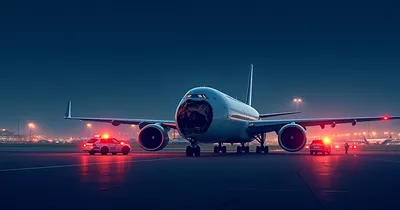
Plane Crash 2026: LaGuardia & Colombia Incidents
On the night of March 23, 2026, two devastating aviation incidents shocked the world within hours of each other — a deadly runway collision at one of America's busiest airports and a military plane crash in South America. These tragedies have prompted urgent questions about air traffic control protocols, runway safety, and what passengers should know about flying today.
What Happened at LaGuardia Airport on March 23, 2026
At approximately 11:45 p.m. on March 23, 2026, Air Canada Express Flight 8646 collided with a fire truck on Runway 4 at LaGuardia Airport in New York City. The impact was catastrophic. Both pilots aboard the regional jet were killed, and 41 passengers and crew members were injured — along with two firefighters who were aboard the fire truck at the time of the collision.
According to NBC News live updates, the aircraft was traveling at more than 90 mph when it struck the fire truck — a force equivalent to a full-speed highway impact, but involving a vehicle with none of the protective engineering designed for crashes. The fire truck sheared off the nose cone of the plane, causing severe structural damage and the deaths of those in the cockpit.
What makes this incident particularly alarming is the chain of communication failures that preceded it. The fire truck was responding to a separate, unrelated incident on the airfield. Air traffic control had initially given the truck the go-ahead to cross the runway — and then issued an instruction to stop, but it was too late. The plane was already on its takeoff roll.
The Colombian Military Plane Crash: A Simultaneous Tragedy
Hours earlier on the same day, a separate and equally alarming aviation disaster unfolded thousands of miles away. A Colombian military C-130 Hercules transport aircraft carrying 121 people crashed shortly after takeoff, killing at least one person and injuring 77 others.
As reported by the Associated Press, the aircraft went down in the Putumayo region of Colombia. The C-130 Hercules is a well-established military transport workhorse used by dozens of nations, making the incident a shock to aviation observers worldwide. At least 77 of the 121 aboard were hospitalized, with injuries ranging from minor to severe.
Details on the precise cause of the Colombian crash remain under investigation, but initial reports suggest the plane encountered serious difficulties shortly after takeoff — a statistically high-risk phase of flight often referred to in aviation safety circles as the "critical eleven minutes."
Why the LaGuardia Collision Was So Destructive
Many passengers and aviation observers have asked: why was this crash so deadly? The answer lies in the fundamental physics of aircraft design.
As aviation experts explained, commercial aircraft are simply not engineered to survive collisions with ground vehicles. Cars are built with crumple zones, bumpers, airbags, and energy-absorbing frames specifically to protect occupants in collisions. Aircraft, by contrast, are designed to be as lightweight as possible — optimized for aerodynamics and fuel efficiency, not ground-level impact resistance.
When a fire truck weighing tens of thousands of pounds strikes a regional jet at the nose — the most structurally vulnerable point of the fuselage — the results are predictably catastrophic for anyone seated at the front of the aircraft, particularly the flight crew.
One survivor, passenger Rebecca Liquori, credited the pilots with potentially saving dozens of lives. She told reporters that the crew applied heavy braking in the moments before impact, slowing the aircraft and reducing the overall force of the collision. Their actions in those final seconds, she said, were almost certainly what allowed most passengers to survive.
"The pilots braked hard before the impact. I truly believe that's what saved us." — Passenger Rebecca Liquori, as reported following the LaGuardia crash
According to additional reporting, the aircraft was traveling at approximately 104 mph at the moment of impact — down from a higher speed earlier in the takeoff roll, suggesting the pilots had indeed begun emergency braking.
NTSB Investigation: What Investigators Are Looking At
The National Transportation Safety Board (NTSB) moved quickly in the hours following the LaGuardia crash. NTSB Chairwoman Jennifer Homendy announced the successful recovery of both the cockpit voice recorder and the flight data recorder from Air Canada Express Flight 8646 — two of the most critical tools for reconstructing the final moments of any aviation accident.
Investigators have also formally requested FAA ASDE (Airport Surface Detection Equipment) replay data — radar and sensor data that tracks the movement of all aircraft and vehicles on an airport's surface. This data will be essential in reconstructing exactly where the fire truck was, when it entered the runway, what instructions air traffic controllers gave, and what the timing of those instructions was relative to the plane's position.
One of the most significant threads of the investigation involves ATC tower staffing. The NTSB confirmed it is verifying preliminary information about how many air traffic controllers were on duty at the time of the incident. Understaffing at ATC facilities has been a persistent concern raised by aviation safety advocates in recent years, and this detail may prove central to understanding how the communication breakdown occurred.
By Monday afternoon, 32 of the 41 injured passengers and crew had already been released from local hospitals — a testament to the survivability of the rear cabin sections, even in such a violent collision.
Airport Operations Resume — But Questions Remain
Flights at LaGuardia resumed later on March 23, following the closure of the affected runway for investigation and debris clearing. For the thousands of travelers passing through one of the nation's most congested airports, the resumption of operations was a practical necessity — but the underlying safety questions remain very much open.
Aviation safety advocates point to several systemic issues this crash highlights:
- Runway incursion protocols — procedures for preventing unauthorized vehicles and aircraft from entering active runways — have long been identified as a critical vulnerability at busy airports
- Communication between ground crews and air traffic control requires redundancy and fail-safes, particularly at night when visibility is reduced
- The role of staffing levels in ATC facilities is now directly under scrutiny as part of the official investigation
- Emergency vehicle operations on active airfields require strict coordination that, in this case, appears to have broken down with fatal consequences
For travelers with upcoming flights through LaGuardia or other major U.S. airports, it is worth noting that runway incursions, while rare, are considered one of the most serious categories of aviation safety events by the FAA and NTSB.
What Travelers Should Know: Aviation Safety in Context
Despite the shock of two incidents occurring on the same day, aviation remains statistically one of the safest forms of transportation in the world. The events of March 23, 2026 are tragedies — but they are also outliers in a system that, on any given day, safely moves millions of passengers worldwide.
However, these incidents do underscore several important realities for travelers:
- Pay attention to the safety briefing. In a runway collision or ground incident, knowing exit locations and brace positions can be lifesaving.
- Seats toward the rear of the aircraft have historically shown higher survivability rates in many types of accidents.
- Keep your seatbelt fastened whenever seated — many injuries in aviation incidents occur from unexpected turbulence or sudden decelerations.
- Follow crew instructions immediately. In the LaGuardia incident, rapid evacuation procedures likely reduced injury severity for many aboard.
The bravery of the Air Canada Express pilots — who died doing their jobs while simultaneously taking action that likely saved dozens of lives — also serves as a reminder of the professionalism and dedication of commercial flight crews worldwide.
Frequently Asked Questions
What caused the Air Canada crash at LaGuardia on March 23, 2026?
Air Canada Express Flight 8646 collided with a fire truck that had been cleared to cross Runway 4 while the plane was in its takeoff roll. Air traffic control gave the fire truck permission to proceed before issuing a stop order — but the instruction came too late to prevent the collision. The NTSB is actively investigating the full sequence of events, including ATC staffing at the time.
How many people were killed in the LaGuardia plane crash?
Both pilots of Air Canada Express Flight 8646 were killed. Forty-one passengers, crew members, and firefighters were injured, with 32 released from the hospital by Monday afternoon. The two firefighters aboard the fire truck were also among the injured.
What happened in the Colombian military plane crash?
A Colombian military C-130 Hercules transport aircraft carrying 121 people crashed on March 23, 2026, shortly after takeoff in the Putumayo region. At least one person was killed and 77 were hospitalized. The cause of the crash is under investigation by Colombian military and aviation authorities.
Is it safe to fly through LaGuardia Airport after the crash?
Flights resumed at LaGuardia Airport later on March 23, 2026. The affected runway was cleared following the investigation's initial phase. Safety protocols remain in effect, and the NTSB investigation is ongoing. Travelers should check with their airlines for any specific flight status updates.
What is the NTSB doing to investigate the LaGuardia crash?
The NTSB has recovered both the cockpit voice recorder and the flight data recorder from the Air Canada aircraft. Investigators have also requested FAA ASDE surface radar data and are verifying information about air traffic control tower staffing at the time of the incident. A full preliminary report is expected in the coming weeks.
Conclusion
March 23, 2026 marked one of the most sobering days in recent aviation history — two deadly incidents on opposite sides of the world, each serving as a stark reminder of how quickly disaster can unfold even within systems designed with safety as the highest priority. The deaths of the Air Canada Express pilots, who braked hard in their final moments to protect the passengers in their care, and the ongoing recovery of survivors from the Colombian military crash, deserve not just our attention but our demand for answers.
The NTSB investigation into the LaGuardia collision will be closely watched by aviation regulators, airlines, and airport operators worldwide. Whether the findings point to communication failures, staffing shortages, protocol gaps, or some combination of factors, the outcome has the potential to drive meaningful safety improvements at airports across the country. For now, travelers and aviation professionals alike are left to grapple with the events of a night that will not soon be forgotten.
Stay Updated
Get the latest trending insights delivered to your inbox.
Sources
- NBC News live updates nbcnews.com
- the Associated Press apnews.com
- shortly after takeoff msn.com
- aviation experts explained yahoo.com
- additional reporting aol.com