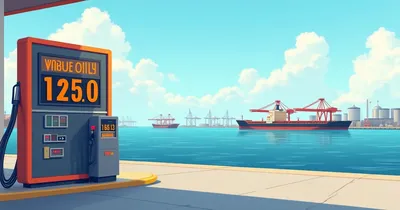
Oil Prices Surge as US-Iran Tensions Grip Global Markets
Global oil markets entered crisis territory in late April 2026 as a dangerous standoff between the United States and Iran sent Brent crude prices soaring and rattled equity markets worldwide. On April 20, 2026, Brent crude jumped 5.3% to $95.21 per barrel after the US seized an Iranian cargo ship accused of attempting to evade an American blockade of Iranian ports — a dramatic escalation that underscored just how fragile the ceasefire framework had become. For investors, energy companies, airlines, and anyone with exposure to consumer-facing businesses, the volatility was a stark reminder of how quickly geopolitical brinkmanship translates into real financial pain.
This isn't just an energy story. It's a story about supply chain vulnerability, the limits of diplomacy under pressure, and the cascading economic consequences when the world's most critical shipping chokepoint gets shut down — again. Understanding what happened, why it matters, and what comes next is essential for anyone tracking global financial markets.
The Strait of Hormuz: A 21-Mile Bottleneck That Controls the World
To understand why oil prices respond so violently to US-Iran tensions, you need to understand the Strait of Hormuz. This narrow waterway — at its tightest point just 21 miles wide — connects the Persian Gulf to the Gulf of Oman and ultimately to the global ocean trading network. Roughly 20% of the world's oil supply passes through it every day, representing approximately 17-18 million barrels. There is no practical alternative route for most of this volume.
When Iran closes the Strait — even temporarily, even as a signaling measure — markets don't wait for confirmation. They price in the worst-case scenario immediately. That's exactly what happened in this cycle. Iran briefly announced on Friday, April 18, 2026 that it would reopen the Strait for commercial traffic. Markets responded with relief: stocks rallied and oil prices fell. Then, on Saturday, April 19, Iran reversed course and closed the Strait again after the US continued its blockade of Iranian ports. By Sunday into Monday, traders were back in panic mode.
The whiplash was brutal for investors trying to read the tea leaves. One day suggesting diplomatic movement, the next suggesting escalation — that kind of uncertainty is exactly what markets hate most, and it showed up in price action across multiple asset classes.
From $119 to $95: The Volatile Price Story in Context
The April 20 spike to $95.21 per barrel was significant, but it's worth contextualizing within the broader arc of this conflict. At the height of initial hostilities, Brent crude briefly exceeded $119 per barrel — a level that hadn't been seen since the supply shock years following the Russian invasion of Ukraine. That peak reflected maximum fear: full closure of the Strait, uncertainty about the scope of military action, and the possibility of a prolonged disruption to Middle Eastern energy infrastructure.
The pullback from $119 to the $80s reflected a combination of diplomatic signals and market skepticism that the conflict would escalate further. But the rebound to $95.21 on April 20 — driven by the cargo ship seizure and renewed Strait closure — confirmed that the crisis wasn't over and that the floor for oil prices had been permanently re-rated upward by the risk premium embedded in Middle Eastern supply.
For long-term investors, the pattern matters as much as any single data point. This is the third time in a decade that US-Iran tensions have produced a triple-digit oil spike. Each time, markets have eventually found equilibrium — but each time, the baseline "normal" price has been somewhat higher than before the crisis began.
Market Fallout: Who Got Hurt and How Much
The April 20 oil surge rippled across equity markets in ways that were entirely predictable and yet still painful for anyone holding the wrong positions. The S&P 500 fell 0.3% from its all-time high, the Dow Jones Industrial Average dropped 71 points (0.2%), and the Nasdaq declined 0.5%. These headline numbers understated the damage in specific sectors.
Airlines took the worst of it. American Airlines dropped 4.7% and United Airlines fell 2.6% in a single session. Airline economics are brutally simple: jet fuel is typically the second-largest operating expense after labor, and it can't easily be hedged when prices move this fast. Even carriers with fuel hedging programs in place face margin compression when spot prices surge this dramatically over a multi-week period. Any investor holding airline stocks through this crisis period absorbed significant losses.
The cruise industry fared only slightly better. Norwegian Cruise Line fell 4.4% and Carnival dropped 1.4% — both heavily exposed to fuel costs across massive fleets that consume enormous quantities of marine fuel. The irony for cruise lines is that high fuel costs hit them at the same time that geopolitical instability tends to suppress consumer confidence and booking activity, creating a double squeeze.
Meanwhile, Petróleo Brasileiro S.A. (Petrobras) and other oil producers in the Western Hemisphere found themselves in an inadvertently advantageous position — their production, far from the conflict zone, was suddenly worth considerably more. Latin American oil assets became a hedge against Middle Eastern instability, with deals like Blue Water's Venezuelan oil agreement with Maha Energy attracting renewed interest precisely because they offer geographic diversification away from Hormuz-dependent supply chains.
The Cargo Ship Seizure: A Significant Escalation
The immediate trigger for the April 20 spike was the US seizure of an Iranian cargo ship that American authorities said had attempted to evade the blockade of Iranian ports. This wasn't just a headline — it represented a meaningful escalation in the direct confrontation between US naval forces and Iranian maritime traffic.
Seizures of this kind create several cascading risks. First, they provide Iran with a justification to retaliate in kind or escalate maritime harassment of US-allied shipping. Second, they test the willingness of third-party nations — China, India, Turkey — to challenge the blockade by continuing to trade with Iran regardless. Third, they create precedents that are difficult to walk back even after a diplomatic resolution, because the seized vessel and its cargo become negotiating chips.
The timing was particularly fraught because a ceasefire between the US and Iran had been set to expire on Tuesday, April 21, 2026 at 8:00 PM Eastern Time. Seizing an Iranian ship less than 48 hours before a ceasefire deadline was either an attempt to maximize leverage before negotiations or a signal that the US was prepared to let the ceasefire lapse. Markets priced in the latter interpretation, at least initially.
For context on the broader geopolitical landscape shaping these events, see World News May 2026: Iran War, Ted Turner & PSG for a comprehensive overview of the forces converging on global markets this spring.
What This Means: An Analytical Perspective
Here's the uncomfortable truth that most market commentary glosses over: the global economy has been operating with a structural dependency on Middle Eastern oil that renewable energy transitions haven't yet meaningfully reduced. The Strait of Hormuz remains as consequential today as it was in the 1970s, and every major oil crisis of the past 50 years has eventually resolved — but each one has also demonstrated that there's no backup plan.
The $95 price point is genuinely dangerous for the global economy in a way that $80 oil is not. At $95, airline profitability disappears for most carriers. Consumer discretionary spending starts to compress as gasoline prices rise. Inflation expectations, which central banks have spent years carefully managing, begin to drift upward again. The Federal Reserve faces an impossible choice: tighten to fight energy-driven inflation, or hold rates to avoid tipping an oil-shocked economy into recession.
The brief rally on April 18 when Iran announced the Strait would reopen was instructive. It showed that markets desperately want a diplomatic exit and will price one in the moment any signal appears. That's actually a somewhat hopeful signal — it means the peace premium is large, and whoever brokers a genuine resolution will unlock significant equity upside across consumer-facing sectors.
But the reversal 24 hours later was equally instructive. It showed that trust between these parties is essentially nonexistent, that announcements can be reversed overnight, and that any "resolution" will need verification mechanisms with real teeth to hold. The ceasefire deadline of April 21 was not a peace deal — it was a pause with a timer attached.
Latin American oil producers — including CNODC Brasil Petróleo e Gás and Pré-Sal Petróleo S.A. in Brazil — may be among the longer-term beneficiaries of this instability. If geopolitical risk becomes a permanent feature of the Middle Eastern supply calculus, the relative stability of Brazilian pre-salt deepwater production becomes a structural competitive advantage. Brazil's offshore reserves are geographically insulated from the Hormuz chokepoint in a way that Gulf producers simply aren't.
Investors looking for equity exposure to oil without Hormuz risk should be watching Petrobras and Western Hemisphere producers closely. The spread between Middle Eastern and Atlantic-basin oil risk premiums is likely to remain elevated even after a ceasefire, as institutional memory of the Strait closures reprices long-term supply security.
For investors tracking the broader market consequences of this volatility, note that even with the S&P 500's modest decline, technology-adjacent names like Oracle have continued to outperform on the strength of defense and AI contracts — a reminder that not all sectors move in lockstep with energy prices.
Historical Pattern: Oil Shocks and Market Recovery Timelines
History offers some useful guidance on how these crises typically resolve. The 1973 Arab oil embargo lasted about five months before gradual relief arrived. The Gulf War spike in 1990-91 resolved within roughly six months. The 2022 post-Ukraine invasion spike took about a year to fully unwind. The common thread: geopolitical oil shocks are almost always temporary, but "temporary" can mean anywhere from weeks to years.
What distinguishes this crisis is the direct involvement of US military and naval forces in the blockade and seizure operations. This isn't a regional conflict where the US is a distant observer applying economic pressure. This is active operational confrontation, which creates escalation pathways that pure economic sanctions don't. The risk of miscalculation — a naval incident that spirals, a retaliatory strike that triggers a response — is meaningfully higher than in past cycles.
That said, both sides have strong incentives to de-escalate. Iran's economy was already under severe stress from years of sanctions before the blockade. The US faces political pressure from domestic consumers experiencing high gasoline prices and from allies whose economies are being disrupted. The question isn't whether both sides want out — they probably do — but whether domestic politics on both sides allows their leadership to accept the compromises a deal requires.
Frequently Asked Questions
Why does the Strait of Hormuz matter so much to oil prices?
The Strait of Hormuz is the only sea route connecting Persian Gulf oil producers — Saudi Arabia, Iraq, Kuwait, UAE, Iran — to global markets. Approximately 20% of the world's daily oil consumption transits this chokepoint. There is no pipeline network or alternative route capable of handling this volume. When the Strait is threatened or closed, the market immediately prices in a potential 20% supply reduction, which is catastrophic for global energy availability. Even a partial closure or credible threat of closure is enough to send prices sharply higher because the downside scenario is so severe.
How high could oil prices go if the conflict escalates further?
Brent crude already exceeded $119 per barrel at the height of the initial conflict — a level not seen since 2022. If the Strait of Hormuz were completely and indefinitely closed, analysts have modeled price scenarios in the $150-180 range in an extended disruption scenario. At those prices, global recession risk becomes very high, as energy costs consume an unsustainable share of consumer and business spending. However, sustained prices above $120 historically trigger demand destruction and accelerate alternative energy adoption, which creates a natural ceiling effect over time.
Which stocks benefit when oil prices rise this sharply?
Energy producers — integrated oil companies, exploration and production companies, and oil services firms — are the primary beneficiaries of higher crude prices. Refining margins also tend to expand during supply shocks. Midstream infrastructure companies benefit from elevated throughput values. Companies like Petrobras that produce oil in geopolitically stable regions can see outsized gains because they capture higher prices without bearing the conflict-zone risk discount. Conversely, energy consumers — airlines, cruise lines, trucking companies, chemicals producers — see margin compression.
What happens to the stock market if a ceasefire holds?
A credible, verified ceasefire would likely trigger a sharp and broad equity rally, with energy-consumer stocks (airlines, cruise lines, logistics) leading the rebound. Oil prices would fall significantly from elevated levels, reducing cost pressures across the economy. The Fed would face less inflationary pressure, potentially allowing for a more accommodative stance. The S&P 500 and Dow, which fell only modestly during the crisis, could reclaim or exceed all-time highs quickly. The critical qualifier is "credible and verified" — a repeat of the April 18 false dawn, where Iran announced reopening only to reverse course, would trigger another selloff.
Should retail investors buy or sell oil-related assets during this volatility?
This requires individual judgment about risk tolerance and time horizon, but some principles apply broadly. Trying to trade geopolitical oil spikes is extremely difficult — the same volatility that creates opportunity also creates the potential for large, fast losses. The April 18-19 reversal demonstrated how quickly a "resolved" trade can become a losing one. Long-term investors may find that Western Hemisphere producers offer a structural trade worth holding through the noise. Short-term traders should be aware that ceasefire news can move prices 5-10% in hours. Any financial decision of this magnitude warrants consultation with a qualified financial advisor — understanding what a CPA or certified financial professional can offer in terms of tax-efficient positioning is also worth considering.
Conclusion: A Crisis That Redraws the Energy Map
The late April 2026 oil price surge was not an anomaly — it was a confirmation of structural vulnerabilities that have existed in the global energy system for decades. The Strait of Hormuz remains a single point of failure for global oil supply, the US-Iran relationship remains fundamentally adversarial, and the financial markets remain acutely sensitive to any disruption of Middle Eastern energy flows.
What's different now is the directness of the confrontation. Blockades, seizures, and ceasefire deadlines are the language of active conflict, not distant economic pressure. The $95 Brent price reflects that reality. Even if the ceasefire holds and diplomacy ultimately prevails, the risk premium embedded in energy prices is unlikely to fully dissipate — institutional investors have now seen how quickly $80 oil becomes $119 oil, and they'll demand compensation for holding that exposure.
The longer-term winners may be the oil producers furthest from the conflict zone: Brazilian deepwater assets, North American shale, West African offshore. The longer-term losers are the assumptions that the post-Cold War global trading system — built on the premise of reliable access to Middle Eastern energy — can be taken for granted. It cannot. And the price of that lesson is being paid, $95 at a time, at the pump and in portfolios worldwide.