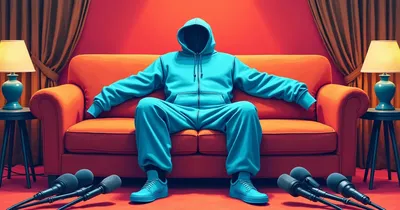
When Netflix dropped Hulk Hogan: Real American on April 22, 2026, it didn't just document the life of a wrestling legend — it cracked open a family still navigating grief, unresolved wounds, and the complicated legacy of a larger-than-life figure who died before some of those wounds could heal. In the weeks since, both of Hulk Hogan's children have gone public with their reactions, and their divergent responses tell a more complete story than the docuseries itself managed to capture.
Nick Hogan participated in the four-part series and has emerged as a cautious optimist, focused on honoring his father's legacy through future projects like a potential biopic. Brooke Hogan, meanwhile, chose not to participate — and her explanation for that decision is as revealing as anything in the documentary itself. Together, their responses illuminate what happens when a public figure's myth collides with the private reality their family actually lived.
The Netflix Docuseries That Reignited Everything
Hulk Hogan: Real American arrived eight months after the wrestling icon's death from a fatal heart attack at age 71 in July 2025. The timing was deliberate — close enough to the loss that grief is still raw, far enough that the family had some distance to reflect. The four-part series promised an intimate look at one of professional wrestling's defining figures, and by several accounts, it delivered on parts of that promise.
Perhaps the most significant element is Hulk Hogan's final interview, recorded before his death and included in the docuseries. In it, he admitted to heavy fentanyl use during his wrestling career — a revelation that recontextualizes much of his career-era behavior — and acknowledged an affair with Brooke's former friend and assistant. These aren't minor footnotes. They're the kinds of disclosures that family members have to sit with publicly, whether they wanted them aired or not.
For Nick Hogan, who appears in the series, watching those segments was genuinely difficult. Nick has admitted the documentary was difficult to watch, a candid acknowledgment that participation in a project doesn't make its contents easy to absorb when they involve your own family's pain.
Brooke Hogan's Absence — and What It Signals
Brooke Hogan's decision to stay out of the docuseries was not a quiet one. On April 27, 2026, she sat down with Extra to explain her thinking, and what she said deserves to be taken seriously rather than dismissed as a celebrity PR move.
Her central complaint: the documentary was "missing 98 percent of real life." That's not a minor quibble about editing choices. It's a fundamental objection to the frame — a suggestion that the version of Hulk Hogan presented onscreen was curated in ways that left out complexity, accountability, and the experiences of people most affected by his decisions.
Brooke also said she felt there was no accountability from her father in the project, and that she "never really got a genuine apology." What makes this statement particularly striking is the follow-up: her forgiveness, she explained, came from love — not from reconciliation. That's a distinction worth sitting with. It means she found a way to peace that didn't require her father to fully reckon with how his choices affected her. That's emotionally sophisticated, but it's also a quiet indictment of what the documentary apparently didn't capture.
The affair with her former friend and assistant — disclosed in Hulk Hogan's final interview — sits at the center of this. It's one thing to learn your parent had affairs. It's another to learn that one involved someone within your own inner circle, a person you trusted. That Brooke had to watch this play out on a Netflix docuseries viewed by millions, without having been given a genuine apology while her father was alive, goes some way toward explaining why she kept her distance from the project.
Nick Hogan's More Optimistic Stance
Nick Hogan's posture toward his father's legacy is meaningfully different from his sister's. On April 28, 2026, he appeared on 83 Weeks with Eric Bischoff — the podcast hosted by the former WCW president who was himself a central figure in the Monday Night Wars era that made Hulk Hogan a mainstream phenomenon — and talked about what comes next for his father's story.
The conversation naturally turned to the long-gestating Hulk Hogan biopic. This project has had a troubled history: it was previously in development with director Todd Phillips attached and Chris Hemsworth expected to play the Hulkster, before ultimately being cancelled. The cancellation left fans wondering whether the project would ever be revived, particularly after Hulk Hogan's death changed the calculus around it entirely.
Nick's assessment was optimistic. He said he believes there is "absolutely potential" for the biopic to happen, and specifically addressed the casting question that had defined so much of the project's early buzz. His take on Hemsworth: the Australian actor would "play a great Hulk Hogan." That's a meaningful endorsement from the son of the subject — it suggests that whatever complications arose around the project's cancellation, Nick at least doesn't view the Hemsworth-Hogan pairing as a mismatch.
Whether a biopic now happens is a genuinely different question than it was before. The docuseries has refreshed public interest in Hulk Hogan's story. The revelations in his final interview have complicated that story in ways that a traditional biopic would have to grapple with. And the fact that Hulk Hogan is no longer alive to participate — or to exercise any influence over how he's depicted — means a future film would have to navigate the interests of his estate, his children, and a fan base with wildly different ideas about what his story means.
A Family Legacy Complicated by Fame
The Hogan family dynamics visible in this moment have roots stretching back decades. Terry Bollea — Hulk Hogan's legal name — was one of the most recognized figures on earth during the 1980s and 1990s. His children grew up in that atmosphere, which meant growing up as extensions of a brand as much as members of a family.
The family's public profile intensified during the mid-2000s with the reality show Hogan Knows Best, which aired the family's daily life to television audiences and made Nick and Brooke Hogan recognizable figures in their own right. Nick later became the subject of significant media coverage following a 2007 car crash that left his passenger, friend John Graziano, with permanent brain damage — a moment that tested the family publicly in ways that had nothing to do with wrestling.
Brooke pursued a music career with mixed commercial results but genuine artistic ambition, often navigating the strange position of being both famous and perpetually overshadowed by her father's larger-than-life persona. Nick moved through various entertainment projects while managing the ongoing weight of his own legal history.
Both children, in other words, have had to construct identities in the presence of a figure whose gravity was extraordinary. The docuseries arrives at a moment when that figure is gone, and the question of who gets to define his legacy — and on what terms — is suddenly open in a way it wasn't before.
What the Docuseries Got Right — and What It Left Out
Based on available accounts, Hulk Hogan: Real American succeeds as a document of the public Hogan — the wrestling arc, the cultural moment, the transformation from territorial circuit journeyman to global phenomenon. The Monday Night Wars context, the WWF years, the Hollywood crossover attempts: this is well-documented territory, and a four-part Netflix series has enough room to cover it with reasonable depth.
Where it appears to fall short — and this is Brooke Hogan's core critique — is in the private Hogan. The admissions in the final interview are significant, but admissions aren't the same as accountability. A person can confess to an affair or acknowledge substance use without engaging with how those choices rippled outward to the people closest to them. If the docuseries framed those confessions as moments of late-life honesty rather than examining what was left unrepaired, that gap is exactly what Brooke is pointing to.
This is a tension that runs through most legacy documentaries about complicated figures. The subject's own perspective, even when candid, will always be incomplete. The people most affected are the ones who can fill in what's missing — which is precisely why Brooke's absence makes the final product feel, by her own account, like a partial portrait.
What This Means for the Hogan Legacy Going Forward
The immediate question is the biopic. If the docuseries performs well on Netflix — and early indicators suggest there's genuine audience appetite for it — it makes the commercial case for a feature film stronger. A biopic would have a different set of pressures: it would need to dramatize rather than document, make choices about which version of Hulk Hogan to center, and navigate the family's very different relationships to that story.
Nick's optimism about the project is strategically useful: it signals that at least one family member would support rather than resist a film. Whether Brooke's more complicated feelings would translate into active opposition or simply continued non-participation is unknown. But the two positions aren't necessarily incompatible with a biopic moving forward.
The deeper question is about how public figures who were genuinely complicated get remembered. Hulk Hogan was a transformative presence in American entertainment — his contributions to wrestling's crossover into mainstream culture are undeniable. He was also, by the account of his own daughter, someone who caused real harm to the people closest to him and didn't fully reckon with it before he died. Both of those things are true simultaneously.
The wrestling world is familiar with this tension. Careers in professional wrestling often carry personal costs that fans never fully see, and the mythology that surrounds wrestling legends tends to paper over complexity in favor of legacy. Whether Hogan's story gets told in a way that holds both the icon and the flawed human in the same frame will depend on who gets to tell it next.
Frequently Asked Questions
Why didn't Brooke Hogan participate in the Netflix docuseries?
Brooke Hogan told Extra on April 27, 2026, that she felt the docuseries was "missing 98 percent of real life" and that there was no genuine accountability from her father in the project. She also revealed she never received a real apology from Hulk Hogan for things that happened in her personal life, including his affair with her former friend and assistant. Her forgiveness of her father, she explained, came from love rather than from any true reconciliation.
What did Hulk Hogan reveal in his final interview included in the docuseries?
In the final interview, recorded before his death and included in Hulk Hogan: Real American, Hulk Hogan admitted to an affair with Brooke Hogan's former friend and assistant, and disclosed heavy fentanyl use during his wrestling career. Both revelations are significant — the fentanyl admission reframes some of his career-era behavior, while the affair touched his daughter's personal life directly.
Is the Hulk Hogan biopic still happening?
As of late April 2026, there is no confirmed greenlit production, but Nick Hogan said on 83 Weeks with Eric Bischoff on April 28 that he believes there is "absolutely potential" for a biopic. The previous version of the project — with Todd Phillips directing and Chris Hemsworth expected in the lead role — was cancelled before production began. Nick expressed confidence that Hemsworth would "play a great Hulk Hogan," suggesting the casting was never his objection to the project.
When did Hulk Hogan die, and how?
Hulk Hogan died in July 2025 from a fatal heart attack at age 71. His death preceded the Netflix docuseries by roughly nine months, making the project a posthumous examination of his life and career rather than a documentary he could participate in shaping in real time.
What is 83 Weeks with Eric Bischoff?
83 Weeks is a podcast hosted by Eric Bischoff, the former WCW president who was one of the central architects of the Monday Night Wars — the period in the mid-to-late 1990s when WCW and WWF competed directly for television ratings and pay-per-view revenue. Hulk Hogan's defection to WCW in 1994 was one of the watershed moments of that era, making Bischoff a natural host for conversations about Hogan's legacy.
Conclusion
The release of Hulk Hogan: Real American has done what the best legacy projects do: it's forced a public reckoning with the distance between a figure's public myth and private reality. What's emerged in the weeks since is a portrait of two siblings processing that distance in genuinely different ways — Nick oriented toward legacy-building and future projects, Brooke insisting that what was left unsaid matters as much as what made the final cut.
Neither position is wrong. Nick's optimism about a biopic reflects a real opportunity: the docuseries has refreshed audience appetite for Hogan's story at a moment when that story has new dimensions. Brooke's insistence on accountability reflects something equally real: that the people closest to a legend carry costs the mythology doesn't account for, and that a documentary which skips over those costs isn't actually telling the whole story.
Whether a biopic eventually gets made — and whether it's the kind of film that takes Brooke's critique seriously — will say something about what Hollywood believes audiences actually want from stories about complicated icons. The smart bet is that the version with genuine complexity is more interesting than the hagiography. Whether it's more commercially viable is the question the industry will have to answer.