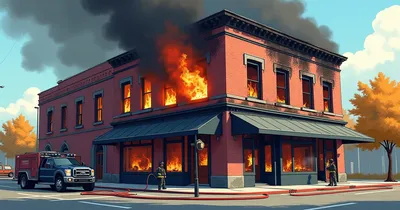
In the early hours of May 6, 2026, flames tore through one of the Twin Cities' most beloved lakeside landmarks. Haskell's Port of Excelsior — a bar, restaurant, and liquor store that has anchored the corner of Water and Lake Street in Excelsior, Minnesota since 1934 — sustained significant fire damage overnight, sending shockwaves through a community that has spent generations gathering at its shores. No one was hurt, but the loss felt by locals runs deep. For a building that has weathered over nine decades of Minnesota winters and changing tastes, this fire marks an uncertain chapter for an irreplaceable piece of Lake Minnetonka history.
What Happened: A Timeline of the Overnight Fire
The emergency call came in at approximately 1:30 a.m. on May 6, 2026, according to CBS News Minnesota. By the time firefighters arrived at the iconic waterfront address, the fire had already taken hold inside the restaurant portion of the building. What followed was a coordinated, large-scale response that would stretch across the predawn hours.
Firefighters from five separate departments converged on the scene — a mobilization that speaks to both the severity of the blaze and the significance of the structure. After roughly 90 minutes of active firefighting, crews managed to bring the fire under control. The effort was not without consequence: the restaurant portion of Haskell's sustained what officials described as "fairly extensive damage."
One of the night's critical wins was containment. KSTP reports that firefighters successfully prevented the blaze from spreading into the adjoining liquor store, a significant operational consideration for any potential recovery and reopening. No injuries were reported among either the responding crews or any individuals at the property.
The owner was on-site in the aftermath, working directly with investigators as they began the process of determining a cause. As of the morning of May 6, the cause of the fire remained unknown and under active investigation.
Haskell's Port of Excelsior: Over 90 Years of History on Lake Minnetonka
To understand why this fire is more than just a property damage story, you have to understand what Haskell's actually represents. The establishment first opened its doors in 1934 — the depths of the Great Depression, during Prohibition's final year — and has operated continuously ever since. That kind of longevity is vanishingly rare in the restaurant and bar industry, where the average independent establishment fails within five years.
Situated at the corner of Water and Lake Street in Excelsior, Minnesota, Haskell's occupies prime real estate on Lake Minnetonka's eastern shore, one of the most desirable and recreationally active lake systems in the Upper Midwest. The town of Excelsior itself is a compact, walkable lakeside community with a strong identity tied to its historic downtown and waterfront access. Haskell's wasn't just a business here — it was part of the fabric of the place.
The establishment operated across three functions: a full-service bar and restaurant, and a liquor store housed in the same building. That combination made it a multi-purpose destination — somewhere you could grab a meal after a day on the water, have a beer with neighbors, or pick up a bottle of wine for a dinner party. The integration of those three functions under one roof at such a prominent corner location made Haskell's uniquely embedded in daily community life.
"It's an institution." — Interim Excelsior Fire Chief Nate Basinger, speaking to reporters about Haskell's Port of Excelsior following the fire.
That's not a throwaway quote. When a fire chief uses the word "institution" about a building he just spent the night fighting to save, it reflects a widely shared sentiment. According to reporting from MSN, Basinger's comments echoed the community's broader understanding of just how central this place had become.
The Firefighting Response: Five Departments, One Building
The scale of the response to the Haskell's fire deserves attention. Mobilizing five fire departments to a single structure fire is not routine — it reflects either a fire that grew faster than initially reported, a building with particular structural or logistical challenges, or both. Excelsior's location on a lakeside peninsula also means that access for equipment and mutual aid logistics requires coordination that goes beyond a typical urban or suburban response.
The 90-minute containment timeline is worth contextualizing. For a commercial structure of Haskell's age — the building's bones trace back to at least the mid-20th century — older construction techniques and materials can accelerate fire spread in ways that newer fire-resistant construction does not. Lathe-and-plaster walls, aged wood framing, and decades of accumulated materials can make older commercial buildings particularly challenging to fight fires in, even when the footprint is relatively modest.
The fact that crews successfully isolated the fire to the restaurant section and kept it from consuming the adjacent liquor store is a meaningful tactical achievement. Liquor stores present obvious accelerant risks — a fire that breached that space could have turned a damaging fire into a catastrophic one. The containment decision likely involved strategic choices about where to concentrate suppression efforts and where to build firebreaks within the structure.
As of the morning of May 6, fire crews remained on-scene to assess structural integrity, search for hot spots, and support the active investigation into the cause, according to MSN's coverage.
What "Fairly Extensive Damage" Actually Means for a Restaurant Recovery
The phrase "fairly extensive damage" is a measured understatement in the language of post-fire assessments. For a restaurant, extensive fire damage typically involves not just the visible char and structural compromises, but the cascading secondary damage from smoke, soot, and — critically — water. The water used to suppress a large commercial fire can cause damage that rivals or exceeds the fire itself, saturating floors, walls, ceilings, electrical systems, and commercial kitchen equipment.
For a building operating as a food service establishment, any fire event triggers mandatory health and safety inspections before any portion of the operation can legally resume. The kitchen, where health codes govern everything from surface materials to ventilation systems, would require full assessment and likely significant remediation even in areas not directly touched by flame.
The liquor store's survival is genuinely good news from a recovery standpoint. If the structure can be secured and the liquor store portion deemed safe and free of smoke contamination, it's theoretically possible that segment of the business could resume operations sooner than the restaurant — providing some revenue continuity during what is likely to be a lengthy and expensive rebuilding process.
For context on how food safety events can ripple through an establishment's operations, even incidents far less severe than a fire can trigger extended closures — something communities have seen with contamination-related closures at national chains. The Haskell's situation is fundamentally different in nature, but the operational and reputational recovery arc shares some similarities.
Community Reaction: Why Locals Are Mourning More Than a Building
Places like Haskell's Port of Excelsior carry a kind of social weight that is difficult to quantify but easy to feel. Ninety-two years of continuous operation means that the current generation of regulars may be the third or fourth family to make the establishment part of their lives. Grandparents who brought their children there in the 1970s now bring grandchildren. Summer rituals — arriving by boat, parking bikes out front, watching the sun go down over the lake — become so embedded in community memory that losing the venue feels like losing the ritual itself.
Lake Minnetonka's seasonal hospitality economy also concentrates this kind of attachment. Unlike year-round urban establishments where a fire might disrupt a neighborhood's routine, a lakeside bar and restaurant in a small town like Excelsior is a fulcrum for community life from Memorial Day through Labor Day. A fire in early May — right at the threshold of the season — amplifies the stakes for both the owner and the community.
The fact that the owner was present on-site in the early morning hours, working with investigators rather than leaving the scene to others, signals both personal investment and the kind of owner-operated culture that makes places like this different from chain restaurants. Independent establishments built over generations don't survive primarily because of business strategy — they survive because their owners treat them as legacies.
What This Means: Analysis and Implications
The fire at Haskell's raises questions that extend beyond one building on one corner in one small Minnesota town. It's a case study in the fragility of irreplaceable community institutions — the kind of places that exist only because someone, usually a family, made a generational commitment to staying put and staying open.
The practical path forward for Haskell's will depend on several factors that are not yet clear: the structural engineering assessment of what remains, the scope of insurance coverage relative to actual replacement costs, and critically, the owner's decision about whether to rebuild in place, rebuild with modifications, or pursue a different path entirely. Historic structures often face a painful calculus when it comes to fire damage — the authentic materials and construction methods that give them their character are simultaneously the most expensive and difficult to restore faithfully.
Excelsior and the broader Lake Minnetonka community would almost certainly rally around a rebuild effort. These kinds of fires frequently mobilize local support in ways that can accelerate fundraising and community pressure on regulatory processes, potentially easing the path toward rebuilding. But good intentions don't resolve the structural, financial, and regulatory hurdles that stand between a fire-damaged building and a reopened business.
There is also the question of what this fire represents in the broader context of aging commercial infrastructure. Buildings that date to the 1930s and 1940s were not built to modern fire suppression standards. Many lack sprinkler systems or have sprinkler systems that were retrofitted imperfectly. As these structures age and their value — both economic and cultural — becomes harder to separate from their original form, communities face recurring decisions about how much to invest in fire safety retrofits versus accepting the risk. Haskell's serves as a painful reminder of what's at stake when those investments are deferred.
Frequently Asked Questions
Was Haskell's Port of Excelsior completely destroyed by the fire?
No. While the restaurant portion of the building sustained what officials called "fairly extensive damage," the fire was contained to that area. Firefighters successfully prevented the blaze from spreading to the adjacent liquor store in the same building. The full extent of the structural damage is still being assessed, but the building was not a total loss as of the morning of May 6, 2026.
Were any people hurt in the Haskell's fire?
No injuries were reported. This is notable given that five fire departments responded and crews spent approximately 90 minutes actively fighting the blaze. Both the responding firefighters and any individuals associated with the property came through the incident without physical harm.
What caused the fire at Haskell's in Excelsior?
As of May 6, 2026, the cause of the fire has not been determined. The owner was on-site working with investigators, and the cause remains under active investigation. Fire investigators typically examine electrical systems, kitchen equipment, and other potential ignition sources during their assessment of a commercial kitchen fire, though no specific cause has been identified or ruled out at this time.
When will Haskell's reopen?
No reopening timeline has been announced. Following a fire of this scale, a commercial food service establishment must complete structural assessments, health and safety inspections, insurance claims processing, and necessary repairs or rebuilding before any portion of the business can resume operations. Given the description of "fairly extensive damage" and the need for investigation, a reopening timeline could range from weeks to months depending on the scope of repairs required.
How long has Haskell's Port of Excelsior been open?
Haskell's has been in continuous operation since 1934, making it over 90 years old at the time of the fire. It is located at the corner of Water and Lake Street in Excelsior, Minnesota, on the shores of Lake Minnetonka. Interim Excelsior Fire Chief Nate Basinger described it as "an institution" — a characterization that reflects its deep roots in the local community and its multigenerational significance to the area.
Conclusion: A Community Holds Its Breath
The overnight fire at Haskell's Port of Excelsior is a story about much more than property damage. It's about what happens when a community loses — even temporarily — one of the physical places where its identity is stored. The corner of Water and Lake Street in Excelsior, Minnesota has been home to this establishment for over nine decades, through wars and recessions, changing tastes and ownership transitions. That kind of staying power earns a building something beyond commercial value.
The immediate news is about as good as it could be given the circumstances: no injuries, fire contained before it consumed the entire structure, the owner engaged and cooperative with investigators, five departments working through the night to save what could be saved. The harder work starts now — the assessments, the decisions, the fundraising, the paperwork, and ultimately the choice about what Haskell's becomes next.
For a place that has survived since 1934, there is reason for cautious optimism. But the community gathered along Lake Minnetonka this summer will be watching that corner of Water and Lake Street with a particular kind of hope — the kind that only attaches to places that have earned it over generations.