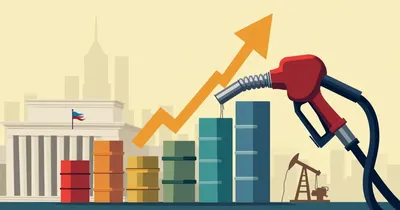
On April 14, 2026, the International Monetary Fund delivered a stark warning to the world's finance ministers and central bankers gathered in Washington: the global economy has entered dangerous territory. The IMF's World Economic Outlook for April 2026 downgraded global growth projections and raised the specter of a worldwide recession — not because of financial excess or a debt bubble, but because of war.
The U.S.-initiated conflict in Iran has done in weeks what trade disputes and monetary tightening took years to accomplish: it has materially darkened the economic horizon for nearly every country on earth. Oil markets are disrupted. The Strait of Hormuz — one of the most critical chokepoints for global energy — has seen shipments halted. And the IMF is now warning that if the conflict persists, the global economy could tip into recession.
This is not a routine downgrade. It is a signal that geopolitical risk has become the defining variable in the 2026 economic equation.
The Numbers: How Far the IMF Has Cut Its Forecasts
To understand the severity of the revision, it helps to trace where the IMF's projections were before the Iran war began. According to the Associated Press, the IMF had been prepared to project global growth of 3.4% for 2026 — matching the actual growth rate achieved in 2025. In January 2026, before the war erupted, the Fund had already trimmed that to 3.3%, reflecting other headwinds. Now, with the conflict underway, the official April 2026 forecast stands at just 3.1%.
That may sound like a modest decline — three-tenths of a percentage point — but in macroeconomic terms, the difference between 3.4% and 3.1% global growth represents hundreds of billions of dollars in lost output, slower job creation, reduced trade volumes, and tighter conditions for developing economies that were already struggling with debt service burdens.
The trajectory tells the real story: in four months, the global growth forecast dropped by 0.3 percentage points. The war alone accounts for the majority of that revision, and the IMF has been explicit about it.
What the IMF Is Actually Saying — and Why It Matters
IMF chief economist Pierre-Olivier Gourinchas did not mince words at the spring meetings press briefing. "The global outlook has abruptly darkened following the outbreak of war in the Middle East," he said — language that is unusually blunt for an institution known for diplomatic understatement.
More revealing still was the IMF's acknowledgment that even a short-lived war has already caused lasting damage. This is a critical point that markets and policymakers risk underestimating. War disrupts supply chains, raises uncertainty, and forces repricing of risk across asset classes. Even if a ceasefire were announced tomorrow, oil infrastructure would take time to restore, insurance premiums for tankers operating in the Gulf would remain elevated, and business investment decisions that were deferred or cancelled would not simply snap back.
The IMF also warned that the global economy is at risk of recession if the Iran war persists. This is the scenario that finance ministries around the world are quietly stress-testing: an extended conflict that keeps the Strait of Hormuz closed, sends oil prices to levels that crush consumer spending, and forces central banks to choose between fighting inflation and supporting growth — a dilemma with no good answer.
The Strait of Hormuz: Why This Chokepoint Changes Everything
To understand why the Iran war has such outsized economic consequences, you have to understand the Strait of Hormuz. This narrow waterway between Iran and the Arabian Peninsula is the transit point for approximately 20% of the world's total oil supply and a significant share of global liquefied natural gas. There is no viable alternative route that can absorb those volumes quickly or cheaply.
When oil shipments through the Strait are halted — as they have been following the outbreak of conflict — the effects cascade globally within days. Spot prices spike. Refinery margins shift. Airlines, shipping companies, and manufacturers scramble to hedge or absorb higher energy costs. Import-dependent economies in Asia, Europe, and emerging markets face immediate inflationary pressure.
This is not a theoretical risk that the IMF is modeling. It is already happening. The disruption to oil markets is live, and its effects are flowing through energy prices, import costs, and business confidence in real time. The question is not whether this damages the global economy — it already has — but how much more damage accumulates before the situation resolves.
For investors watching related signals, wholesale inflation was already hitting a 3-year high before the war escalated, making the energy shock land on an already-sensitized price environment.
Inflation Risk: The Second Shock
The IMF's warning about inflation deserves particular attention. The Fund has warned that the world is already drifting toward a more adverse scenario, one where oil disruptions fuel inflation precisely at a moment when many central banks had declared victory over post-pandemic price pressures.
The mechanics are straightforward but the policy response is anything but. Higher oil prices raise transport costs, which raises prices for virtually everything that moves — which is virtually everything. Food prices, already elevated in many emerging markets, face additional pressure. Manufacturing input costs rise. Consumers in energy-intensive economies see their real purchasing power eroded.
Central banks that had been on the verge of cutting interest rates now face an uncomfortable choice. Cutting rates to support growth risks reigniting inflation. Holding rates steady or raising them to fight inflation risks tipping already-fragile economies into contraction. This is the stagflation trap: slow growth and rising prices simultaneously, the most difficult macroeconomic environment to navigate.
The Fed, the ECB, the Bank of England, and their counterparts across the emerging world are all watching the same data and facing the same dilemma. The IMF's recession warning is, in part, a warning that this policy trap exists and could snap shut.
Washington's Response: A Tale of Two Agendas
The spring meetings of the IMF and World Bank brought together the world's most powerful economic officials at a moment of acute crisis. But the public messaging from the U.S. Treasury revealed a notable divergence in priorities.
Treasury Secretary Scott Bessent, representing the administration that initiated the Iran conflict, used his platform at the spring meetings to call for the IMF and World Bank to refocus on their core missions — a long-standing conservative critique of multilateral institutions that have expanded into climate, gender, and governance work. Bessent also identified China's trillion-dollar trade surplus and what he called the "slow motion buildup of global imbalances" as the biggest risk to the global economy.
Notably absent from Bessent's public remarks: any direct acknowledgment of the Iran war's economic impact.
This disconnect — between the IMF's explicit attribution of the growth downgrade to the war and the U.S. Treasury's silence on that point — is itself economically significant. It suggests that the U.S. does not intend to treat the economic consequences of the conflict as a constraint on its military policy. That, in turn, means global investors and policymakers cannot rely on economic damage alone to shorten the conflict's duration.
For corporate strategists and investors, this matters. Bank earnings and financial sector forecasts heading into Q1 2026 reporting season are being reassessed against this backdrop of elevated uncertainty.
What This Means: An Informed Analysis
The IMF's April 2026 World Economic Outlook is more than a forecast — it is a diagnosis of a world that has crossed a threshold. For roughly two decades after the 2008 financial crisis, the primary threats to global growth were financial: debt, leverage, asset bubbles, and monetary policy miscalibration. Then came the pandemic's supply shocks and the Ukraine war's energy disruptions. Now, a new conflict has layered geopolitical risk directly onto energy markets in a way that is immediate, severe, and hard to hedge.
Several implications follow from this analysis:
- Emerging market vulnerability is acute. Countries that import oil and have limited fiscal space to absorb higher energy costs face the most severe near-term risk. Many were already dealing with elevated debt service costs from the post-pandemic rate cycle.
- The recession threshold is closer than the headline number suggests. A 3.1% global growth forecast averages across wildly divergent national outcomes. Some major economies are likely to contract; others will absorb the shock better. The average masks significant tail risk at the country level.
- Supply chain reconfiguration will accelerate. Businesses that had already been diversifying away from single-source supply chains — driven by the pandemic and the U.S.-China trade conflict — now have additional urgency to reduce exposure to Middle East energy dependencies.
- The policy toolkit is limited. Central banks cannot fight both inflation and recession simultaneously with conventional tools. Fiscal policy is constrained by elevated debt levels in most major economies. The IMF and World Bank are the backstop lenders of last resort for the most vulnerable countries — which is precisely why Bessent's call to narrow their mandates was ill-timed.
The broader corporate environment is already showing stress signals. Major companies have begun significant workforce reductions in 2026, reflecting the anticipatory adjustment that precedes a recognized slowdown.
Historical Context: How War-Driven Economic Shocks Have Played Out
The 1973 OPEC oil embargo — triggered by geopolitical conflict in the Middle East — remains the most instructive historical parallel. It pushed U.S. inflation above 12%, helped tip multiple major economies into recession, and fundamentally reshaped energy policy for a generation. The 1990 Gulf War produced a shorter but still significant oil price spike that contributed to the 1990-91 recession in the United States.
What distinguishes the current situation is the combination of factors: a conflict directly involving Iran (which controls the northern shore of the Strait of Hormuz and has the capacity to threaten tanker traffic), an already-elevated global inflation environment, high levels of sovereign debt that limit fiscal responses, and a fractured multilateral order that reduces the likelihood of a coordinated global response.
The IMF's warning that the world is "already drifting toward a more adverse scenario" echoes the language economists used in 2007-2008 — when the institution was similarly warning of tail risks that ultimately materialized. The Fund has learned, painfully, that it is better to over-communicate downside risks than to be caught flat-footed. The April 2026 WEO should be read with that institutional history in mind.
Frequently Asked Questions
Why has the IMF cut its global growth forecast for 2026?
The IMF cut its 2026 global growth forecast from 3.3% (January projection) to 3.1% primarily because of the economic fallout from the U.S.-initiated war in Iran. The conflict has halted oil shipments through the Strait of Hormuz, disrupted energy markets, and raised the risk of higher inflation globally. IMF chief economist Pierre-Olivier Gourinchas described the outlook as having "abruptly darkened" following the war's outbreak.
Could the Iran war cause a global recession?
Yes — the IMF has explicitly warned that a global recession is possible if the conflict persists. The mechanism is primarily through energy markets: if the Strait of Hormuz remains closed for an extended period, oil prices could rise to levels that crush consumer spending and corporate investment globally, while simultaneously forcing central banks to choose between fighting inflation and supporting growth. This stagflation scenario is the IMF's most adverse case.
What is the Strait of Hormuz, and why does it matter so much?
The Strait of Hormuz is a narrow waterway between Iran and the Arabian Peninsula through which approximately 20% of the world's oil supply transits. It is one of the most critical energy chokepoints on earth. There is no quick, cost-effective alternative route for the volumes that normally pass through it. When shipments are halted — as they have been since the outbreak of conflict — global energy markets feel the impact almost immediately.
How does the war affect inflation?
Higher oil prices raise transportation and manufacturing costs, which flow through to consumer prices across almost every sector. This is particularly damaging in countries that import most of their energy. The IMF has warned that the war-driven disruption to oil markets could fuel inflation at a moment when many central banks had been hoping to cut interest rates. If inflation re-accelerates, those rate cuts become impossible, increasing the risk of economic contraction.
What are the biggest economic risks beyond the immediate oil shock?
Beyond the immediate energy disruption, the IMF and independent economists point to several compounding risks: the erosion of business and consumer confidence that comes with geopolitical uncertainty; the fiscal stress on emerging market economies that import oil and have limited buffers; the political pressure on central banks to act in contradictory directions simultaneously; and the longer-term structural shifts in energy and supply chain policy that elevated geopolitical risk will accelerate. Treasury Secretary Bessent's identification of global trade imbalances — particularly China's surplus — as a separate long-term risk adds another layer of complexity that pre-dates and outlasts the current conflict.
The Road Ahead: Navigating an Abruptly Darker World
The IMF's April 2026 World Economic Outlook will be remembered as a document that marked a turning point — the moment when the economic costs of the Iran war became officially, quantifiably real. A global growth forecast of 3.1% is not catastrophic on its own. But the direction of travel, the distribution of risks, and the limited policy room available to respond all point toward a world where the margin for error has shrunk considerably.
The war's economic damage, as the IMF noted, has already been done — regardless of how quickly the conflict ends. Insurance premiums, investment decisions, supply chain adjustments, and inflation expectations do not instantly revert to pre-war levels once hostilities cease. The scars will take time to heal, and the healing will be uneven: wealthier, energy-independent economies will recover faster; poorer, energy-importing ones will carry the burden longer.
What policymakers, investors, and businesses should take from this moment is not panic, but clear-eyed realism. The IMF has laid out the risks plainly. The question is whether the world's economic stewards — including the U.S. Treasury, whose policy choices created the current situation — are willing to engage with those risks honestly and act accordingly.
For now, the spring meetings in Washington have produced more clarity about the problem than about the solution. That gap is itself a risk worth watching.