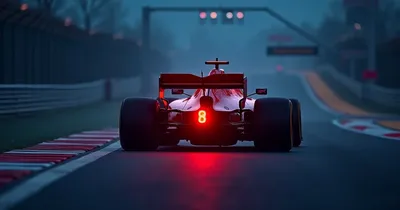
Formula Drift has always occupied a peculiar, exhilarating corner of American motorsport — too wild for purists, too technical for casual observers, and too spectacular for anyone to ignore once they've seen two cars sliding sideways in precise formation at 90 miles per hour. As the 2026 season opens at Long Beach, California, the series is marking twenty years at one of its most iconic venues with a rare convergence of milestones: a permanent Hall of Fame monument, a landmark broadcast deal, and a car lineup that includes a 1,300-horsepower Mustang wearing a livery pulled from deep space imagery. This isn't just another season opener. It's a statement about where Formula Drift has been — and a serious argument for where it's going.
Twenty Years at Long Beach: Why This Anniversary Actually Matters
When Formula Drift first ran at Long Beach in 2006, competitive drifting in the United States was barely three years old as an organized series. The sport had no Hall of Fame, no major broadcast partners, and no guarantee it would survive long enough to matter. The Long Beach street circuit — the same one that hosts the Acura Grand Prix of Long Beach for IndyCar — lent the young series instant credibility, placing drifting alongside established motorsport on one of North America's most recognized tracks.
Twenty years later, 2026 is shaping up to be one of the most significant years in Formula Drift's history at Long Beach. The series has returned to this venue consistently, building a relationship with the event and the city that now feels genuinely historic. Hosting the season opener here — coinciding with the Grand Prix weekend — guarantees a massive, mixed crowd of motorsport fans who might be Formula Drift regulars, curious IndyCar attendees, or first-timers drawn in by the noise and smoke. That cross-pollination has always been part of Long Beach's value to the series.
The decision to anchor the 20th anniversary celebration at Long Beach, rather than staging it at a purpose-built or more controlled venue, says something important about Formula Drift's identity. Street circuits are harder, less forgiving, and more dramatic than dedicated drift tracks. Choosing to celebrate here is a deliberate alignment with the sport's raw, high-stakes character.
The Hall of Fame Monument: Permanent Recognition on the Course
On April 9, 2026, Formula Drift unveiled a Hall of Fame monument near the Long Beach Grand Prix circuit. The design is specific and considered: it incorporates tire compound patterns drawn from the very first Formula Drift Long Beach race in 2006, creating a visual link between the inaugural event and the present. This isn't a generic trophy or a plaque in an office — it's a permanent fixture at the venue, meant to be seen by spectators and competitors alike during race weekends.
The first inductee celebrated at the monument this year is Dai Yoshihara, the 2011 Formula Drift champion. Yoshihara's career arc mirrors the series' own growth — he came up through the sport during its formative years, competed at the highest level for over a decade, and became one of the recognizable faces that helped establish Formula Drift's legitimacy with both casual fans and hardcore enthusiasts. His induction in April 2026 is the right call, and the timing, at the 20-year Long Beach mark, gives it weight beyond a standard year-end award.
The Hall of Fame monument serves a function beyond nostalgia. Formula Drift has historically struggled with the same challenge that confronts many niche motorsports: casual fans often can't name the champions. Permanent, visible recognition at a high-traffic venue is a low-cost, high-visibility way to build institutional memory and make the series feel like something that has roots worth knowing about.
The Racer Network Deal: A New Era for Formula Drift Broadcasting
Broadcast deals can make or break a motorsport series' ability to grow beyond its core fanbase, and Formula Drift's new exclusive agreement with Racer Network represents the most significant shift in how the series reaches viewers in years. Formula Drift's broadcast evolution has always been tied to the challenge of presenting a judged, subjective sport to audiences accustomed to finish-line results.
The Racer Network partnership brings new schedule segments and viewing methods — specifics that suggest the coverage is being rebuilt from the ground up rather than simply moved to a new platform. Racer Network has an existing reputation for motorsport-specific content, which matters. Generic sports broadcasters often struggle with Formula Drift because the scoring system — based on judging criteria including line, angle, style, and chase proximity — requires explanation and context that a production team unfamiliar with the sport will inevitably fumble.
An exclusive deal also concentrates audience, which is valuable for sponsors and teams. Fragmented viewership across platforms dilutes the metrics that brands use to justify investment. A single home for Formula Drift coverage, with consistent production quality and an audience that knows where to find it, makes the series a more attractive commercial proposition for the manufacturers and sponsors whose budgets keep the cars on track.
The Cars: Engineering Extremes in the 2026 Field
Formula Drift's technical diversity is one of its most underappreciated qualities. Unlike spec series where identical machinery levels the playing field, Formula Drift allows competitors to build genuinely different machines — and the 2026 field demonstrates exactly how wide that range can be.
Connor O'Sullivan's entry is a case study in purposeful incongruity: a E46-generation BMW 3 Series running a GM LS V8 engine. The GM LS V8 swap into European chassis is a well-established tuner tradition — the engine's combination of power potential, parts availability, and relative simplicity makes it a logical choice for a competition car that will spend its life at high RPM and high stress. O'Sullivan's build represents the grassroots-to-professional pipeline that gives Formula Drift much of its character: cars that look factory-adjacent but are fundamentally reimagined underneath.
At the opposite end of the spectrum is the Mustang RTR-Spec 5-FD, the flagship machine of RTR Vehicles' team. The car produces 1,300 horsepower — a figure that would have been extraordinary even for top-fuel drag racing not long ago — and carries a livery drawn from imagery captured by the James Webb Space Telescope. The Webb telescope connection is more than a graphic design choice; it positions the car as part of a broader cultural moment around space exploration and scientific imagery that has generated genuine public fascination. When the Mustang RTR-Spec 5-FD made its public debut at the 2023 Formula Drift Long Beach opener, it immediately became the visual centerpiece of the series.
RTR Vehicles fields a formidable roster: two-time Formula Drift champion Vaughn Gittin Jr., Chelsea DeNofa, Adam LZ, and James Deane. That combination of championship pedigree, technical expertise, and social media reach — LZ has built a massive audience documenting his motorsport journey — makes RTR arguably the most complete team in the paddock from a commercial and competitive standpoint.
Ford's Electronic Drift Brake: When Motorsport Shapes Production Cars
One of the more interesting throughlines in the 2026 season narrative is the story of how Formula Drift competition directly influenced a production vehicle feature. The 2024 Ford Mustang's Electronic Drift Brake was developed with direct input from Vaughn Gittin Jr. and Chelsea DeNofa, both of whom have spent their careers understanding exactly what a car needs to initiate and maintain a controlled slide. The result delivers three times the braking force of a traditional parking brake — a specification that makes it genuinely useful for drift initiation rather than a gimmick badge on an options list.
The 2024 Ford Mustang with Performance Pack carrying this system represents a meaningful transfer of motorsport knowledge to the consumer market. It's the kind of feature that enthusiasts will notice and that validates the argument that Formula Drift is doing real development work, not just putting on a show.
This technology transfer narrative matters for the series' relationship with manufacturers. When automakers can point to a specific production feature that came from their Formula Drift program, the investment calculus changes. It stops being pure marketing spend and becomes R&D with a consumer application — a much easier internal budget conversation to win.
What This Means for the Sport's Trajectory
Formula Drift enters 2026 in better structural shape than it has occupied for much of its history. The combination of a permanent Hall of Fame presence, an exclusive broadcast home with a motorsport-specialist partner, a technically diverse and visually spectacular field, and a 20-year milestone at one of North America's premier street circuits creates conditions for genuine growth.
The sport's core challenge has always been converting spectacle into sustained attention. Drifting is immediately, viscerally impressive — the smoke, the noise, the proximity of competing cars. But translating that visceral impact into the kind of sustained fan engagement that builds season-long narratives, fantasy competitions, merchandise sales, and the other infrastructure of mainstream motorsport requires consistent, quality media coverage and identifiable stars. The Racer Network deal addresses the first; the RTR team's roster addresses the second.
The parallel with other niche motorsports that have successfully scaled — golf's evolution in prize money and viewership offers one framework for thinking about how specialized sports build broader audiences — suggests that the combination of compelling personalities, accessible broadcast platforms, and event co-location with larger properties (like the Long Beach Grand Prix) is a proven growth pathway.
Formula Drift isn't chasing Formula 1 numbers. But it doesn't need to. A well-defined, loyal fanbase with strong manufacturer support and a broadcast partner that understands the product is a sustainable and valuable position. The 2026 season opener at Long Beach looks like the beginning of a chapter where the series starts capitalizing on twenty years of groundwork.
Frequently Asked Questions About Formula Drift
How is Formula Drift scored?
Formula Drift uses a judging system that evaluates competitors on three primary criteria: line (following a predetermined course through the track), angle (the degree of sideslip maintained through the course), and style and speed (the overall impression of commitment, speed, and control). In tandem battles — the head-to-head competition format — judges also evaluate how closely the chase car tracks the lead car's line. A panel of three judges scores each run, and the scores are combined to determine advancement. The subjectivity of the system is sometimes criticized, but it also allows for the sport's theatrical quality: judges reward commitment and spectacle, which incentivizes drivers to push harder than a purely objective system might.
What makes Long Beach significant for Formula Drift?
Long Beach has hosted Formula Drift since 2006, making it the longest-running venue relationship in the series' history. The street circuit's combination of tight corners, concrete walls, and urban spectator access creates conditions that showcase drifting particularly well. The co-location with the Acura Grand Prix of Long Beach also gives Formula Drift access to a broader motorsport audience that might not seek out a standalone drifting event. The 2026 season opener marks the 20th anniversary of this relationship, which the series is commemorating with a permanent Hall of Fame monument at the circuit.
How much horsepower do Formula Drift cars make?
Top-tier Formula Drift Pro Championship cars typically produce between 900 and 1,500 horsepower, though there's no hard upper limit enforced by the ruleset. The Mustang RTR-Spec 5-FD runs at 1,300 horsepower. Most cars use turbocharged or supercharged four- or six-cylinder engines, though V8-powered entries like Connor O'Sullivan's E46 BMW 3 Series with a GM LS V8 remain competitive. The power figures are relevant because initiating and maintaining a drift at competition speeds requires both explosive torque for entry and controllable power delivery throughout the run — a combination that pushes engine development in specific directions.
Who are the top teams in Formula Drift right now?
RTR Vehicles is arguably the most prominent team in the 2026 field, running Vaughn Gittin Jr. (a two-time champion), Chelsea DeNofa, Adam LZ, and James Deane in Mustang RTR-Spec 5-FD cars. Beyond RTR, the Pro Championship field includes a mix of manufacturer-backed and privateer entries. Formula Drift pros have demonstrated at high-profile events including auto shows and exhibition events, which reflects the commercial investment teams and manufacturers are making in the series' visibility.
Can you watch Formula Drift on streaming platforms?
The 2026 season marks a new chapter for Formula Drift broadcasts through an exclusive deal with Racer Network. The partnership brings new schedule segments and viewing formats designed to improve access and fan engagement compared to previous broadcast arrangements. Racer Network specializes in motorsport coverage, which should mean production quality that reflects an understanding of the sport's technical nuances rather than treating drifting as a novelty act within a broader sports broadcast. Check Racer Network's official channels for the most current schedule and access information for the 2026 season.
Conclusion: A Sport at an Inflection Point
Twenty years at Long Beach is not just a number. It represents two decades of building relationships between a sport and a city, between competitors and fans, between manufacturers and a platform that demonstrates what their vehicles can do at the edge of physical possibility. The 2026 season opener arrives with more structural support — a broadcast partner, a Hall of Fame, a roster of technically extraordinary machines — than Formula Drift has had at any previous milestone.
The series has earned its longevity by remaining genuinely spectacular while evolving its infrastructure to support growth. The Hall of Fame monument with its 2006 tire compound design is a perfect emblem of that balance: roots acknowledged, but the cars on track in 2026 are producing 1,300 horsepower and wearing imagery from the edge of the observable universe. That's not nostalgia. That's a sport that knows where it came from and has no intention of slowing down.