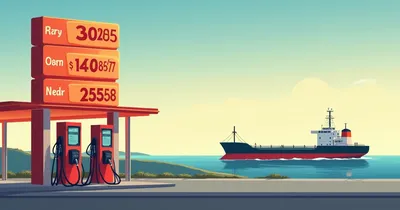
For the first time in six weeks, UK drivers have seen a small but significant reprieve at the pump. Diesel prices dropped 0.6p and petrol fell 0.3p on April 17, 2026 — modest numbers that carry enormous weight after one of the most severe fuel price shocks in recent British history. To understand why this matters, you have to understand what caused prices to explode in the first place, and why the road back to normalcy will be long and uncertain.
The trigger was the effective closure of the Strait of Hormuz, the narrow waterway between Iran and Oman through which roughly a fifth of the world's oil flows. Following the US-Israel military engagement with Iran, the strait was functionally shut for six weeks — long enough to send Brent crude past $119 a barrel and UK diesel soaring from 142p per litre to nearly 192p. A temporary ceasefire has allowed oil markets to breathe, but the structural vulnerability that created this crisis hasn't disappeared. Reporting on the UK pump price data confirms that diesel now sits just below 191p per litre and petrol just under 158p — still historically elevated, still painful, and still well above where either was two months ago.
The Strait of Hormuz: Why One Waterway Controls Your Fuel Bill
The Strait of Hormuz is 21 miles wide at its narrowest point, but its economic reach is planetary. Saudi Arabia, Iraq, the UAE, Kuwait, and Iran all depend on it to move their oil to global markets. When it closes — even partially, even temporarily — the entire oil supply chain convulses.
What happened in March and April 2026 was not a blockade in the traditional sense. It was the combination of military activity, insurance market paralysis, and shipping company risk aversion that effectively closed the route. Tankers don't need to be sunk to stop moving — they just need their insurers to walk away, which they did. The Lloyd's of London market, which underwrites a significant proportion of global maritime risk, reportedly suspended new coverage for Hormuz-transiting vessels within days of the conflict escalating. That decision alone was enough to halt oil flows.
The UK imports a substantial portion of its refined fuel from Gulf producers, and even fuel sourced from other regions is priced against Brent crude — which moved in lockstep with Hormuz fears. By mid-March, Brent had crossed $100 a barrel for the first time since the 2022 energy crisis. It peaked at just over $119. Every dollar added to a barrel of crude adds roughly 0.5p to the UK pump price for petrol and slightly more for diesel, given diesel's greater refining complexity.
The Numbers That Tell the Story
The raw data is striking. Diesel moved from 142p per litre in late February to nearly 192p — a rise of 50p over six weeks. Petrol went from 133p to over 158p, a rise of 25p. These aren't minor fluctuations. They represent:
- An extra £26 per tank for diesel drivers compared to late February
- An extra £14 per tank for petrol drivers over the same period
- A situation where 75% of UK adults cited fuel prices as a driver of increased living costs in March, double the 38% who said so in February
That last figure — from an ONS survey — is the one that should command the most attention from policymakers. A doubling of the share of people citing fuel costs as a living cost pressure, in a single month, is an extraordinary economic signal. It speaks to how quickly energy shocks transmit into household finances, and how little buffer most families have.
For context: current prices remain below the summer 2022 peaks, when petrol hit 191.5p per litre and diesel reached 199p at the height of the post-Ukraine invasion energy crisis. But that's cold comfort for drivers who had grown accustomed to the relative stability of 2024 and early 2025 pump prices.
The ceasefire has given oil markets room to retreat, but diesel is still 34% more expensive than it was eight weeks ago. That's not a crisis resolved — it's a crisis paused.
What the Ceasefire Means for Fuel Prices — and What It Doesn't
The temporary ceasefire announcement caused Brent crude to pull back from its $119 peak, and that retreat has begun filtering through to UK pump prices — with the customary lag. Refineries buy crude at spot or forward prices, and the journey from barrel to forecourt typically takes two to four weeks. The 0.6p diesel drop recorded on April 17 reflects crude purchases made when prices were already retreating but still elevated.
The trajectory from here depends on three variables: whether the ceasefire holds, how quickly Hormuz shipping insurance normalizes, and whether OPEC+ chooses to maintain or adjust its output targets in response to the demand destruction that high prices have already caused.
The ceasefire is described as temporary, which means markets are pricing in resumption risk. Brent is unlikely to fall back to $80 territory while diplomatic uncertainty persists. The broader financial market response has been cautious optimism — the Dow Jones surged 868 points on ceasefire hopes, but equity markets are pricing in a best-case scenario that bond markets and oil futures traders are treating with considerably more skepticism.
For UK pump prices, a realistic near-term trajectory might see diesel ease to 185-187p if crude stabilizes around $100-105, but a return to sub-150p levels would require both a durable peace and a significant increase in non-Hormuz oil supply — neither of which is imminent.
The Diesel Premium Problem
One structural issue the crisis has exposed is the persistent and widening gap between petrol and diesel prices. Diesel has consistently risen faster and fallen slower than petrol throughout this episode — a pattern with real consequences for UK households and businesses.
Diesel powers the vast majority of UK freight — lorries, vans, agricultural equipment, construction machinery. When diesel prices spike, the costs don't stay contained to haulage company balance sheets. They move through supply chains and emerge as higher prices on supermarket shelves, delivery surcharges, and construction cost overruns. Regulators have already flagged concern about the 'fuel surcharge' trend, where businesses use elevated fuel costs as cover for broader price increases that outlast the underlying cost shock.
Diesel also powers a disproportionate share of rural transport. Drivers who live in areas without adequate public transport have no alternative — they absorb every penny of pump price increases without the option of switching to a bus or tube. The ONS living cost data reflects this: the burden of fuel price shocks is not evenly distributed. It falls hardest on those with the least flexibility.
For drivers looking to reduce their exposure to fuel cost volatility, investing in a quality fuel economy OBD scanner can help monitor and optimize driving efficiency, while a diesel fuel additive can improve combustion efficiency and reduce per-mile costs during periods of elevated pump prices.
Global Supply Realignment: How Other Countries Are Responding
The Hormuz closure has accelerated discussions about alternative supply routes and sources that were already underway. Australia, facing its own diesel supply pressures, has moved to leverage its LNG export capacity and agricultural trade relationships to negotiate fuel security arrangements. Forbes reports that Australia is using LNG, lamb, and beef as strategic leverage in bilateral deals aimed at securing diesel supply through non-Hormuz channels — an unconventional but pragmatic approach that reflects how seriously governments are taking the supply disruption.
For the UK, the diversification options are more constrained. North Sea production continues to decline, and the political appetite for accelerating domestic extraction has not kept pace with the energy security arguments for it. The UK's heavy dependence on global oil markets for transport fuel means it has limited insulation from geopolitical shocks of this kind.
The crisis has also renewed debate about the pace of the EV transition. Electric vehicles don't buy fuel at forecourts — but they do consume electricity generated by a grid that still runs partly on gas, and the infrastructure buildout required to support mass EV adoption remains years behind the most optimistic schedules. The transition is happening, but not fast enough to provide meaningful relief during acute fuel price shocks in 2026.
What This Means for Household Finances
The fuel price shock of March-April 2026 has arrived at a moment when UK household finances were already under pressure from persistent services inflation, elevated mortgage rates, and subdued wage growth in key sectors. The compounding effect is significant.
Consider the math for a typical dual-income household with two diesel cars, each averaging 10,000 miles per year at 45mpg. At 142p per litre, annual fuel costs total roughly £2,840. At 192p per litre, that rises to approximately £3,840 — an extra £1,000 per year, concentrated into the six weeks of peak pricing. Even with prices now retreating, the household will absorb above-average fuel costs for months as the crude price eases through the supply chain.
For businesses operating vehicle fleets, a fleet fuel card manager system becomes essential during volatile price periods, allowing companies to track per-vehicle fuel expenditure and identify efficiency opportunities in real time.
The broader macroeconomic impact will likely show up in April and May retail sales data, as higher fuel costs crowd out discretionary spending. The aviation sector is also absorbing significant jet fuel cost increases — a pressure point that connects to wider challenges already facing regional airlines, where thin margins leave little room for sustained fuel cost spikes.
Analysis: The Ceasefire Relief Is Real But Fragile
The 0.6p drop in diesel and 0.3p drop in petrol on April 17 is genuinely good news — not because the numbers are large, but because direction matters. Six weeks of uninterrupted price rises had begun to feel structural. The reversal signals that market mechanisms are still functioning: when the underlying supply threat recedes, even partially, prices respond.
But the relief is built on a temporary ceasefire between parties whose fundamental disagreements have not been resolved. The US-Israel-Iran diplomatic situation remains volatile. If hostilities resume — or if even credible threats of resumption emerge — oil markets will spike again, and pump prices will follow within days.
There's also an asymmetry in how fuel prices move. They rise faster than they fall. Retailers pass on crude price increases quickly and pass on decreases slowly — a pattern that has been documented by the Competition and Markets Authority in multiple investigations. Drivers should not expect to see 142p diesel again anytime soon, even if crude retreats to pre-conflict levels. A realistic scenario sees diesel stabilizing in the 175-185p range over the next month if diplomatic conditions hold.
The longer-term lesson is structural. The UK's energy security arrangements leave it exposed to single points of failure in global oil transit. The Strait of Hormuz closure has done more to advance the political case for accelerated energy diversification than years of policy papers. Whether that translates into substantive action — rather than declarations of intent — remains the defining question for UK energy policy in 2026 and beyond.
Frequently Asked Questions
Why did UK diesel prices rise so much faster than petrol prices?
Diesel and petrol are derived from the same barrel of crude oil, but through different refining processes. Diesel also has higher baseline demand globally — it powers freight, agriculture, and industrial equipment worldwide. When supply is disrupted, diesel's tighter global supply-demand balance means it responds more sharply to price shocks. The UK market also has a structural diesel premium reflecting taxation and refinery configuration. During the Hormuz closure, global diesel supply tightened faster than petrol supply, amplifying the pump price divergence.
Will prices go back to where they were before the crisis?
Unlikely in the near term. Diesel at 142p and petrol at 133p reflected a specific supply and geopolitical context that has materially changed. Even with the ceasefire, Brent crude remains elevated, insurance markets are repricing Hormuz transit risk upward on a structural basis, and there's no mechanism to quickly reverse the cost increases that have already moved through supply chains. A gradual decline toward 170-175p diesel is plausible over 6-8 weeks if the ceasefire holds; a return to February levels would require a sustained resolution, not just a pause in fighting.
How does the Strait of Hormuz closure affect prices if the UK doesn't directly import Iranian oil?
Oil is a globally fungible commodity priced on international benchmarks. When Hormuz closes, it doesn't just restrict Iranian oil — it restricts Saudi, UAE, Kuwaiti, and Iraqi exports too, all of which transit the strait. Countries that previously bought Gulf oil are forced to compete for Atlantic Basin and North Sea supply, pushing those prices up even for buyers who never touched Hormuz-transiting cargoes. The UK pays Brent-linked prices, and Brent responds to global supply disruptions regardless of where the physical oil originates.
What can drivers do to reduce their exposure to fuel price volatility?
Beyond route optimization and reducing unnecessary journeys, drivers can use supermarket loyalty schemes that offer fuel discounts, maintain tyre pressure at optimal levels (under-inflation increases fuel consumption by up to 3%), and consider a fuel efficient driving monitor to track and improve consumption habits. For those doing significant mileage, a hybrid vehicle substantially reduces the proportion of costs exposed to pump price volatility. In the medium term, the structural answer is electrification — but that requires infrastructure investment that hasn't materialized at scale.
Are fuel surcharges that businesses are adding legitimate?
Some are, some aren't. Hauliers, couriers, and logistics companies with genuine diesel cost exposure have legitimate grounds to pass on cost increases through transparent fuel surcharges. However, watchdogs have warned that some businesses are using the fuel price environment as cover for broader margin expansion — applying surcharges that exceed their actual fuel cost exposure, or failing to remove them as prices ease. Consumers and business procurement teams should push for surcharge transparency: what is the fuel cost basis, what trigger point removes the surcharge, and is the calculation auditable?
Conclusion
The 0.6p fall in diesel on April 17, 2026 is a milestone — the first downward movement after six weeks of relentless rises that took diesel to 191p and pushed fuel costs to the top of the UK's living cost anxiety list. It is welcome, genuine, and almost certainly incomplete. The ceasefire that triggered the crude price retreat is temporary by design, and the structural vulnerabilities that allowed a single waterway to push UK pump prices to near-record levels have not been addressed.
For drivers, the near-term picture is cautious optimism: prices are falling, and if diplomatic conditions hold, they should continue to ease over the coming weeks. For policymakers, the episode should function as a forcing function — a demonstration, in real-time, of what energy dependence costs when geopolitics intervenes. The Strait of Hormuz will not be the last chokepoint that matters. The question is whether the UK uses this moment to build genuine energy resilience, or simply waits for prices to normalize and moves on.