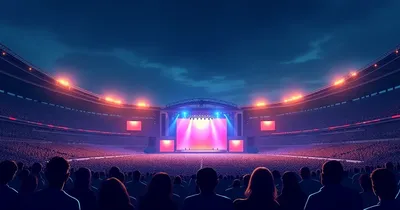
Coachella 2026 will be remembered less for its music and more for the cultural spectacle surrounding it. With Justin Bieber headlining a festival marking its 25th anniversary, the Kardashian-Jenner family commandeering social media feeds, and ticket prices reaching nearly $1,400 before fees, this year's edition crystallized every tension that has been building around the desert gathering for over a decade. "Bieberchella," as fans have taken to calling it, is the clearest sign yet that Coachella has evolved — or devolved, depending on your perspective — into something far bigger, and arguably far stranger, than a music festival.
25 Years in the Desert: How Coachella Got Here
Coachella's origin story is rooted in an act of protest — which makes its current state all the more ironic. In 1993, Pearl Jam famously refused to tour venues controlled by Ticketmaster, protesting the company's rising ticket prices and service fees. That dispute became a rallying cry for artists and fans who believed live music was being priced out of reach for ordinary people. The Coachella Valley Music and Arts Festival emerged from that ethos, holding its first event in 1999 at the Empire Polo Club in Indio, California. It nearly didn't survive: the inaugural festival came dangerously close to shutting down due to insufficient funds.
Twenty-seven years later, the festival that began as an alternative to corporate live music now charges between $549 and $1,399 for three-day general admission passes — not including shuttle passes, camping, or service fees. The very thing Pearl Jam protested has become Coachella's defining characteristic.
The 25th anniversary milestone deserves acknowledgment. Looking back at every Coachella lineup since 1999 reveals a genuinely impressive arc: the festival helped break acts, legitimized electronic music in America, and gave platform to artists who went on to define a generation. Bad Bunny, BLACKPINK, and Frank Ocean headlined in 2023. Lady Gaga, Green Day, and Post Malone took the main stage in 2025. The lineup history is a genuine cultural document. But in 2026, that musical legacy is competing with — and largely losing to — the circus surrounding it.
'Bieberchella': What Justin Bieber's Headlining Slot Actually Signals
Justin Bieber headlining Coachella 2026 is a significant booking by any measure. His career has weathered extraordinary public scrutiny, health challenges, and years of relative absence from touring. A Coachella headlining slot at this moment is a genuine artistic statement — a reclamation of mainstream relevance on one of music's most watched stages. Fans embraced the "Bieberchella" framing enthusiastically, and the social media response ahead of the event was enormous.
But the Bieber booking also illustrates something about where Coachella positions itself today. The festival now gravitates toward artists with maximum cultural cross-pollination — performers whose audiences extend well beyond music fans into fashion, beauty, and celebrity culture. Bieber isn't just a pop star; he's a lifestyle brand, a husband to a major beauty entrepreneur, a figure whose every public appearance generates content. That's exactly what Coachella's expanded ecosystem — which now includes brand activations, celebrity appearances, and influencer marketing — runs on.
The fan nickname "Bieberchella" captures both the genuine excitement and the underlying reality: that individual headliners now generate their own sub-narratives so powerful they can eclipse the festival itself.
The Kardashian-Jenner Coachella Playbook
If Justin Bieber owned the stage, the Kardashian-Jenner family owned everything around it. The family's 2026 Coachella presence was coordinated, comprehensive, and relentlessly documented.
Kylie Jenner opened proceedings on April 10, posting "chelly day 1!!!!!" to Instagram while wearing a Justin Bieber-face tank top and debuting a bedazzled floral manicure clearly inspired by the headliner. It was an efficient move: pay homage to Bieber, generate fashion content, and launch the Coachella content cycle in a single post. Kendall Jenner hosted a cocktail hour in partnership with FWRD, wearing a TOVE dress, while her brand 818 Tequila featured prominently in the activation.
Kourtney Kardashian, meanwhile, hosted Camp Poosh near the Empire Polo Club — a wellness-focused satellite event tied to her lifestyle brand Poosh. This isn't Kourtney's first Coachella rodeo: in 2023, she attended the festival to watch husband Travis Barker perform with Blink-182. But Camp Poosh 2026 represents a significant escalation — an entire branded experience running parallel to the main event. Hailey Bieber added another layer of connectivity by sending Kourtney a Rhode Skincare care package ahead of the festival — a gesture that doubled as brand marketing, neatly tying together the Bieber and Kardashian-Jenner narratives in a single PR moment.
What's striking about the Kardashian-Jenner Coachella operation is its sophistication. These aren't passive celebrity attendees — they're running parallel programming, negotiating brand deals, and generating media coverage that in some cases rivals the festival's own marketing. The lines between attendee, sponsor, and headliner have effectively dissolved.
When the Brands Became the Headline Act
The Kardashian-Jenner presence is a high-profile example of a broader phenomenon that has fundamentally reshaped Coachella's identity. Social media coverage of the festival is now dominated not by performances, but by fashion moments and brand activations. This isn't a recent development — it's been building for years — but 2026 marks what may be a tipping point.
Major brands treat Coachella as a marketing event with a music festival attached. The activations run during festival weekends are elaborate, well-funded, and often more visually compelling than what's happening on the stages. For many of the influencers and celebrities who attend, the actual performances are secondary to the content opportunities the festival environment provides. A set on the main stage competes for attention with a perfectly lit skincare activation in a nearby tent.
This creates a genuine identity crisis for an event that was founded on the premise that music deserved better. The festival's own marketing now leans into the fashion and lifestyle angle — because that's what drives coverage, social engagement, and ultimately, ticket sales. But it's also a signal of how completely the commercialization critics warned about has arrived.
The Real Cost of Coachella: Who Can Actually Afford to Go
The ticket price data tells a stark story. Three-day passes for Coachella 2026 run between $549 and $1,399 — and that's before you account for shuttle passes, camping fees, or Ticketmaster's service charges. Total costs for a realistic Coachella experience — transportation, accommodation, food, merchandise — can easily exceed $2,000 to $3,000 per person.
Consider that against the median household income in the Coachella Valley itself, which includes communities of farmworkers and working-class families who live year-round in the area where this festival takes place. The gap between the economic reality of the region's permanent residents and the wealth on display during festival weekends is profound. Celebrities arrive by private jet and stay in luxury villas. Farmworkers in the same valley work in some of the most physically demanding conditions imaginable. This class divide isn't incidental to Coachella — it's embedded in the geography of the event itself.
The irony of Coachella's founding myth sharpens here. Pearl Jam's 1993 protest was fundamentally about access — about ensuring that live music remained available to fans who couldn't pay premium prices. The festival that grew from that dispute now charges prices that would have been unthinkable in that era, for an event increasingly oriented around the experiences of the wealthy and the content needs of the famous.
What This Means: Coachella as a Cultural Pressure Test
Coachella 2026 isn't just a music festival — it's a pressure test for several larger cultural tensions simultaneously.
The first is the tension between music's cultural value and its commercial value. Coachella's history demonstrates that the two can coexist — but the balance has clearly shifted. When brand activations generate more social media coverage than headlining performances, the festival's core identity becomes genuinely unstable. The question isn't whether Coachella can survive this shift commercially (it clearly can — tickets sell out), but whether it retains any meaningful distinction from a luxury lifestyle event that happens to have stages.
The second tension is the one between celebrity culture and genuine cultural production. The Kardashian-Jenner family didn't create the conditions that make Coachella a celebrity magnet — they're responding to incentives that were already in place. But their dominance of the coverage cycle raises a real question: what does it mean when the most-discussed "headliner" of a music festival is a family attending it?
The third is the accessibility question, which isn't going away. As ticket prices rise and the experience stratifies further — with VIP tiers, branded hospitality experiences, and celebrity-only events running parallel to the main festival — Coachella risks becoming a purely aspirational object rather than an experience its actual audience can access. The festival's 25th anniversary is a moment worth celebrating for its genuine cultural contributions. It's also an appropriate moment to ask what the next 25 years look like, and who they're for.
For those tracking the intersection of celebrity, commerce, and culture, the conversation happening around Coachella rhymes with broader debates in music about authenticity, access, and what gets prioritized when art meets industry at scale.
Frequently Asked Questions
Who headlined Coachella 2026?
Justin Bieber headlined Coachella 2026, with fans and media quickly dubbing the event "Bieberchella." The booking marked one of Bieber's most high-profile live performances in recent years and generated significant anticipation across social media ahead of the festival.
How much do Coachella 2026 tickets cost?
Three-day general admission passes for Coachella 2026 were priced between $549 and $1,399, not including shuttle passes, camping fees, or service fees. Total costs for attending realistically can reach several thousand dollars per person when accommodation and travel are factored in.
What is Camp Poosh at Coachella?
Camp Poosh is a wellness-focused satellite event hosted by Kourtney Kardashian near the Empire Polo Club in Indio, California, running alongside Coachella. It's tied to Kourtney's lifestyle brand Poosh and functions as a branded experience offering alternative programming during festival weekends.
Who headlined Coachella in previous years?
Coachella has featured an impressive headliner roster across its history. In 2023, Bad Bunny, BLACKPINK, and Frank Ocean headlined. In 2025, Lady Gaga, Green Day, and Post Malone took the main stage. A full history of Coachella headliners since 1999 traces the festival's evolving musical identity across decades.
Why is Coachella criticized for commercialization?
Critics argue that Coachella has strayed significantly from its founding ethos — which emerged partly from Pearl Jam's 1993 protest against Ticketmaster's pricing practices — by becoming a platform for brand marketing, celebrity visibility, and luxury experiences. Rising ticket prices, the dominance of brand activations in social media coverage, and the growing stratification of the attendee experience are the most commonly cited concerns. The economic contrast between the festival's wealthy attendees and the working-class communities of the Coachella Valley itself adds another dimension to this critique.
The Bottom Line
Coachella's 25th anniversary is a genuine milestone for an event that has shaped music culture in measurable, lasting ways. "Bieberchella" will generate the kind of cultural conversation that only a handful of live events can produce. The Kardashian-Jenner family's presence — from Kylie's Justin Bieber-face tank top to Kendall's FWRD cocktail hour to Kourtney's Camp Poosh — will dominate entertainment coverage for weeks.
But Coachella 2026 also illustrates, more clearly than any previous edition, the distance the festival has traveled from its origins. An event born from a protest against Ticketmaster now charges $1,399 for a three-day pass. A festival that once celebrated music's power to reach people now generates more social media content around skincare packages and cocktail activations than around performances. These aren't random developments — they're the logical endpoint of two decades of commercialization.
The festival that matters most to the entertainment industry going forward may not be the one where Justin Bieber performs, but the one where the culture figures out what it actually wants from a gathering that once meant something specific. Coachella's next 25 years will be defined by whether it can answer that question honestly — or whether the party is simply too profitable to examine too closely.